I try to use FigMake, Figma’s AI feature around 2025. The goal was to move from wireframe to testable prototype much faster than manual Figma work would allow.
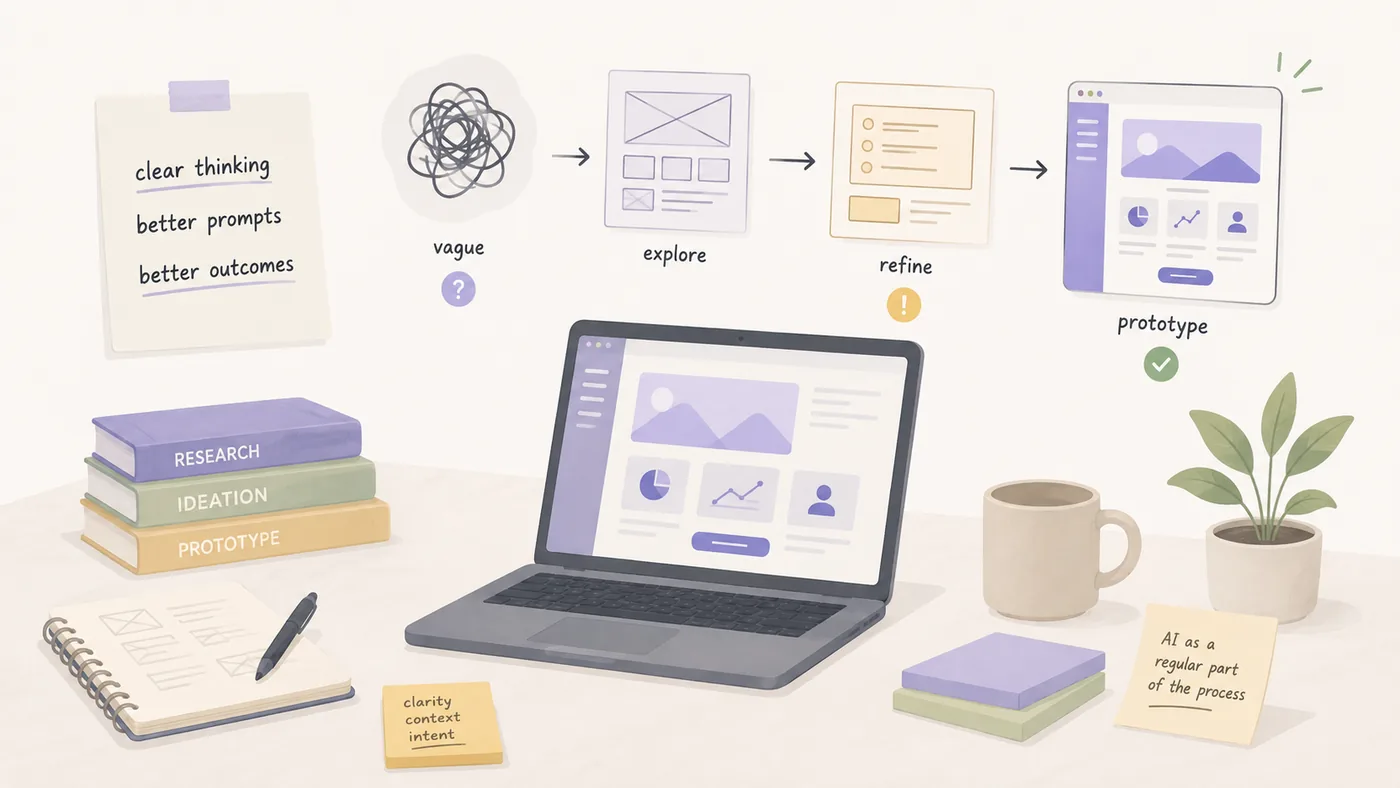
But the first prototype round revealed something important: my early prompts were too vague. I described what I wanted to build without enough context, no mention of the specific user confusion I was trying to address, no clarity on the mental model problem. The outputs were far from what I had in mind.
A vague prompt is a vague brief. If I couldn’t explain what I was building precisely enough for AI to understand it, I probably hadn’t thought it through precisely enough myself.
As I added more specific context, the user journey, the exact confusion I’d observed, the precise copy I wanted, the outputs got progressively closer. The prompting process forced me to be clearer about my own design intent.
The bottleneck in AI-assisted design isn’t the tool, it’s the clarity of your own thinking. The more specific my prompts became, the better the outputs. But what I was really doing was forcing myself to think more clearly about what I was designing and why. AI didn’t replace that thinking. It exposed where it was missing.
Since this project, AI has become a regular part of how I work as a designer, for research, ideation, and prototyping.