Project · Replacement Order Module
Solving the Right Problem to Make Operations 70% Faster
The CE team was using Hangry App to handle replacement orders. It took up to 10 minutes per order. I designed an module in our internal ops dashboard, built around how they actually worked. Then, the replacement order time became 70% faster.
- Product
- Replacement Order Module (part of Internal Ops Dashboard)
- Role
- Research, User Interviews, Product Thinking, UX Writing, UI/UX Design
- Team
- 1 designer (me), 1 Product Manager, and 2 engineers
- Outcome
- Replacement order time became 70% faster
How I Found the Real Problem
The brief came to me in October 2024. The CE team with 10 agents, was handling food replacement orders every week across all of Hangry’s brands, outlets, and sales channels. Every complaint had to be handled individually.
I talked with Regina, the CE team leader. What surprised me most wasn’t the volume, but the time. One replacement order done through the Hangry App took up to 10 minutes. This is a pain point.
TIME PER REPLACEMENT ORDER
Around 10 min/order
Using the Hangry App, a consumer product never built for this workflow
REPLACEMENTS PER WEEK
150-200 orders/week
Hangry runs multiple brands across multiple outlets and platforms.
Four structural problems I’ve found after talked with Regina:
PROBLEM 1
Menu Coverage Gap
Hangry App only shows menus sold directly to customers. Items exclusive to Grab, Gojek, Shopee, don’t exist there. When menu wasn’t available, CE reached out to the outlet directly, disrupting kitchen operations in the process.
PROBLEM 2
Sub-brand Gap
Hangry’s sub-brand only exist on third-party platforms. Some sub-brand items appear under the main brand in the Hangry App, but many don’t. Same workaround. Reach out to the outlet directly, same disruption.
PROBLEM 3
Pricing Gap
Hangry App shows consumer-facing prices. Every replacement placed through it was charged at full retail. No way to use internal pricing or COGS. Every replacement cost more than it should have.
PROBLEM 4
No Centralization
Each CE agent used their own Hangry App account. There was no shared view. No way to track orders, monitor volume, or control costs across the team. Regina had no visibility into what her team was doing.
How I Solved It
The PM’s brief came with a proposed drection: a form that CE fills to place a replacement order, with part of it shared to the customer to input their delivery address and location. A stakeholder also suggested extending this into a WhatsApp chatbot.
I mapped out both flows before we sat down together (me, PM, engineers). Not to commit to either direction, but to have something concrete to pressure-test.
We ran them againts four constraints we had: Did it solve the CE problem? Dit it reduce our replacement order cost? Was it low effort for our customers? Was it low effort for our engineers?
| Idea | CE problem solved | Cost reduced | Low user effort | Low tech effort |
|---|---|---|---|---|
| Option 1 | Yes | Yes | No | No |
| Option 2 | Yes | Yes | No | Yes |
Both option failed on the same constraints, user effort. In both case, the customer still had to fill part of the form and pin point their own location.
In my mind, these are customers who just had a bad experience. Asking them to do anything extra, adds friction to a moment where trust is already thin. But our team almost pushed through anyway, with CE compensating by handling as much a possible. But, something stopped me.
I remembered building the locaton flow for the Hangry App. The pin point feature we used there was powered by a paid mapping service. We can’t use that. A fifth constraint had just appeared, “It will added another business cost” if we continue with these plan.
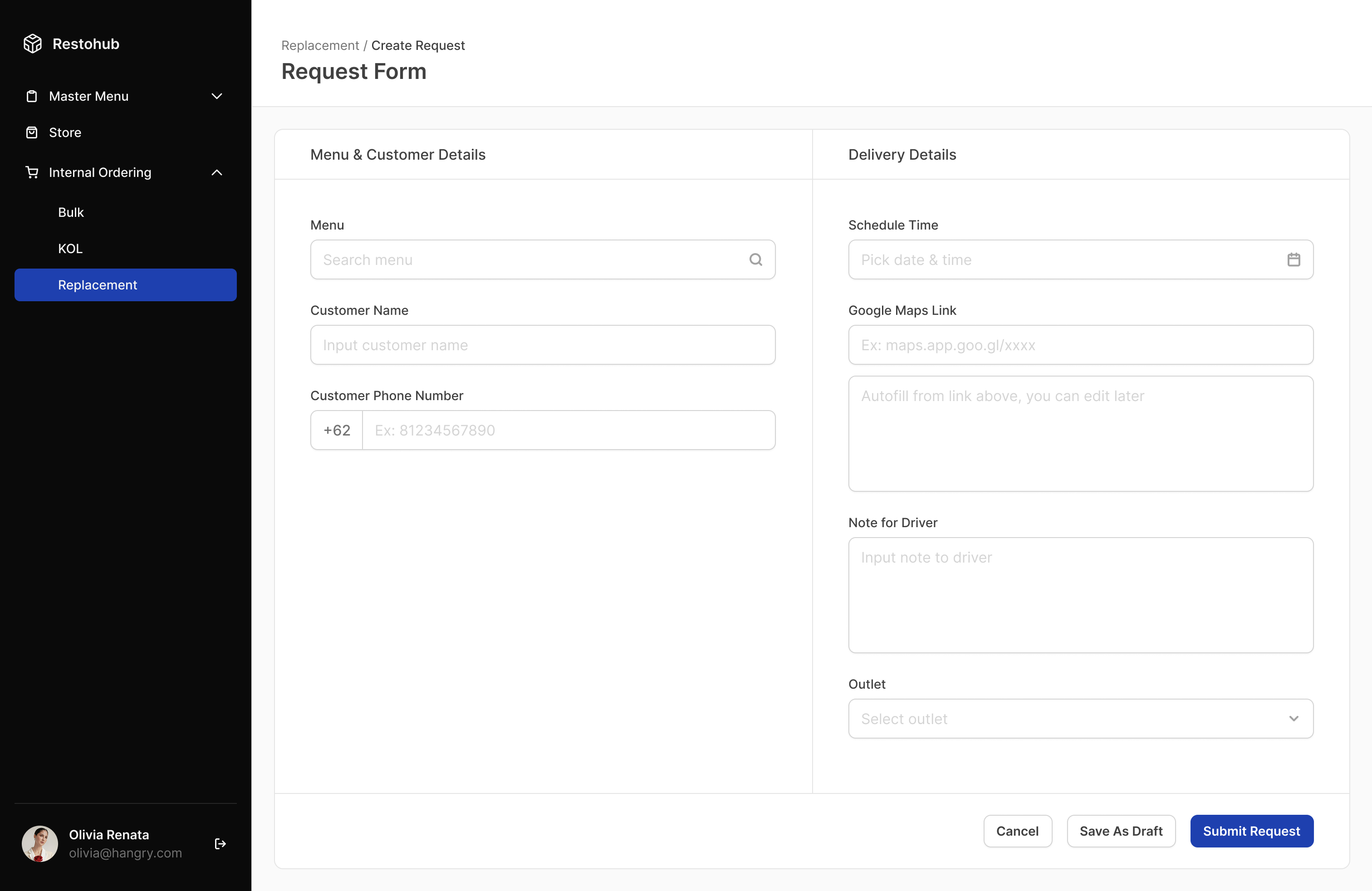
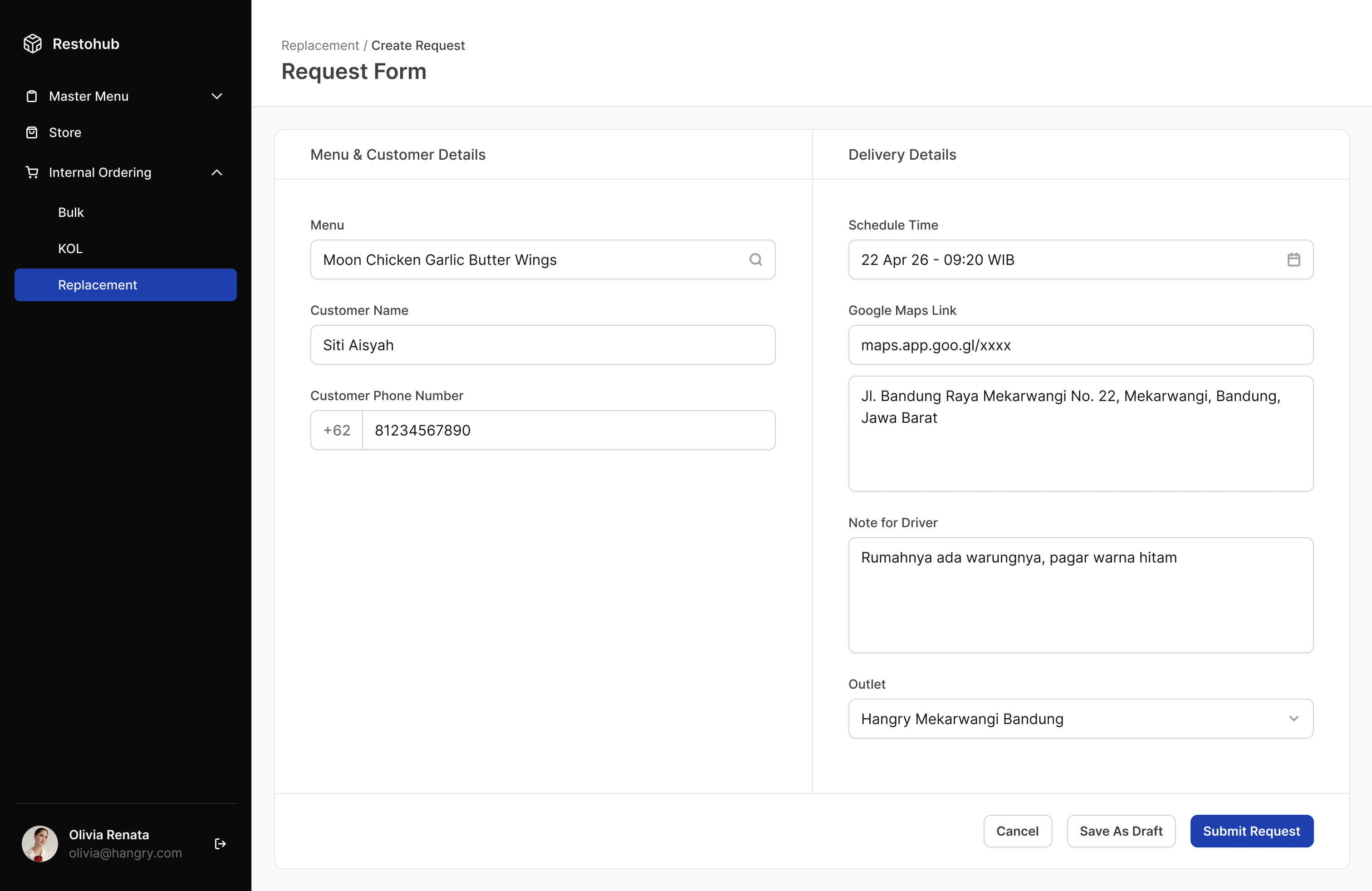
That’s when the Google Maps link idea came up to my mind. Share links already contain latitude and longitude data. CE could simply ask the customer to share their Google Maps location. After we checked it together, it worked and it was free. This will removed all the burden from above.
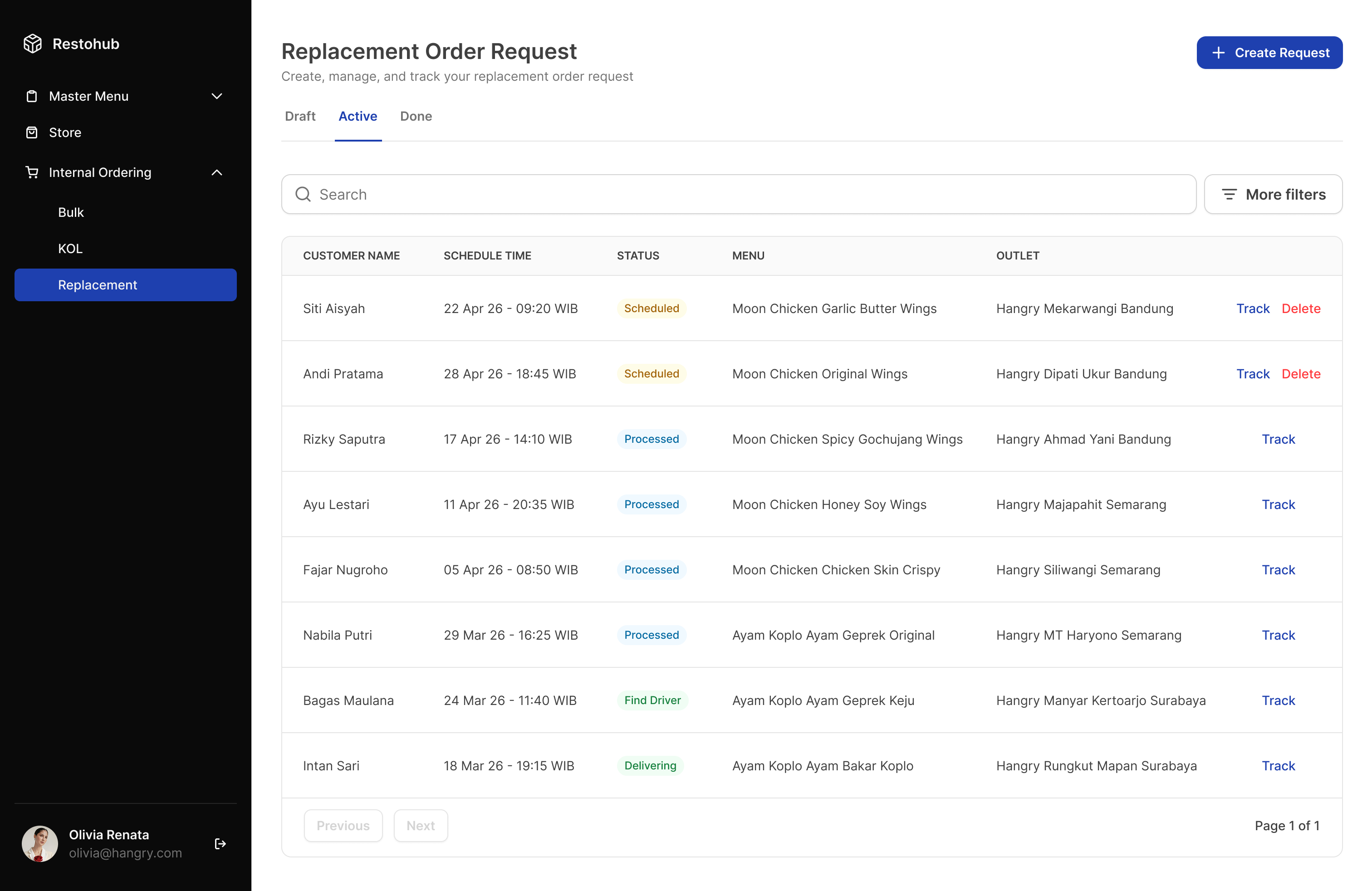
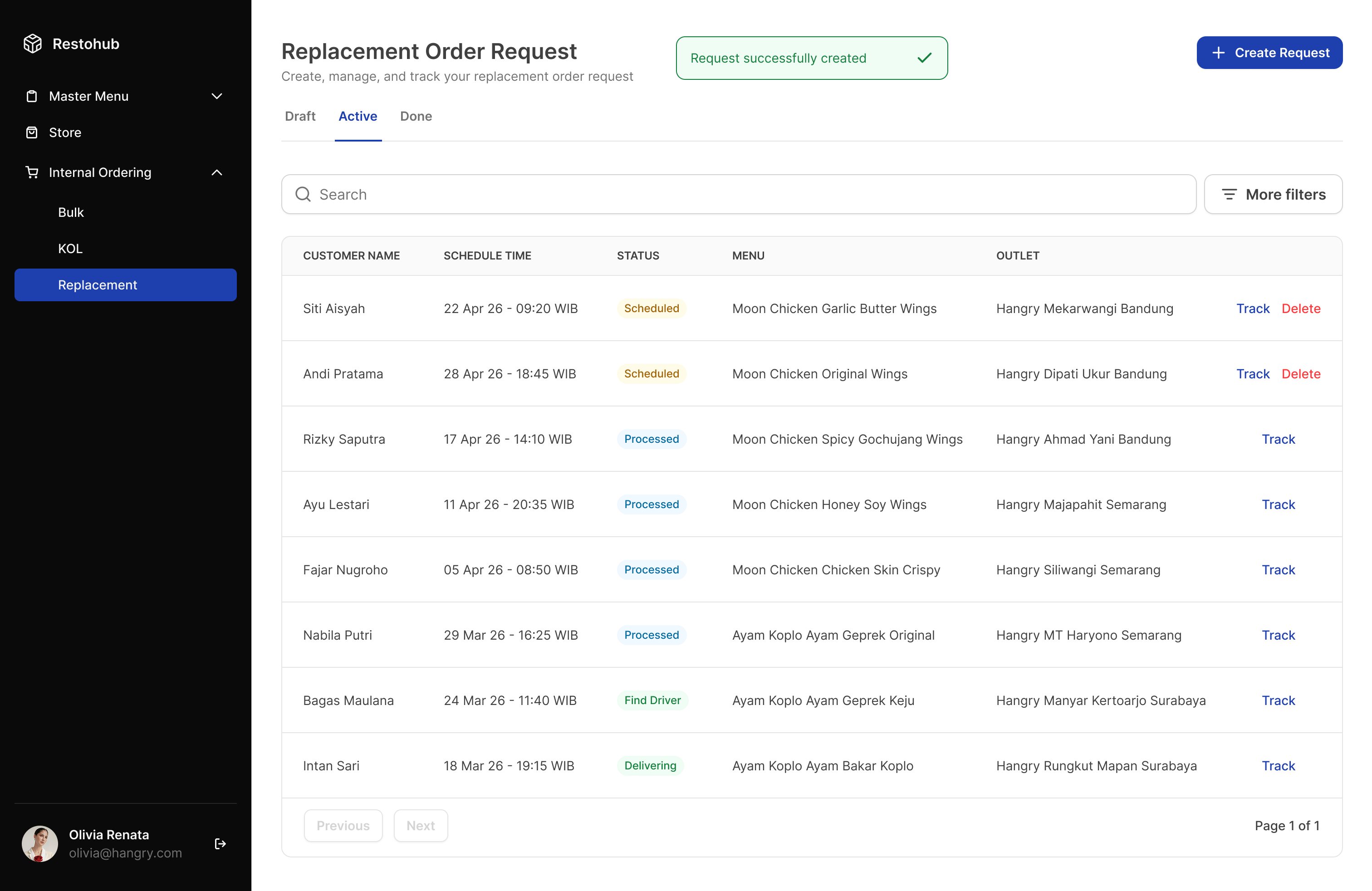
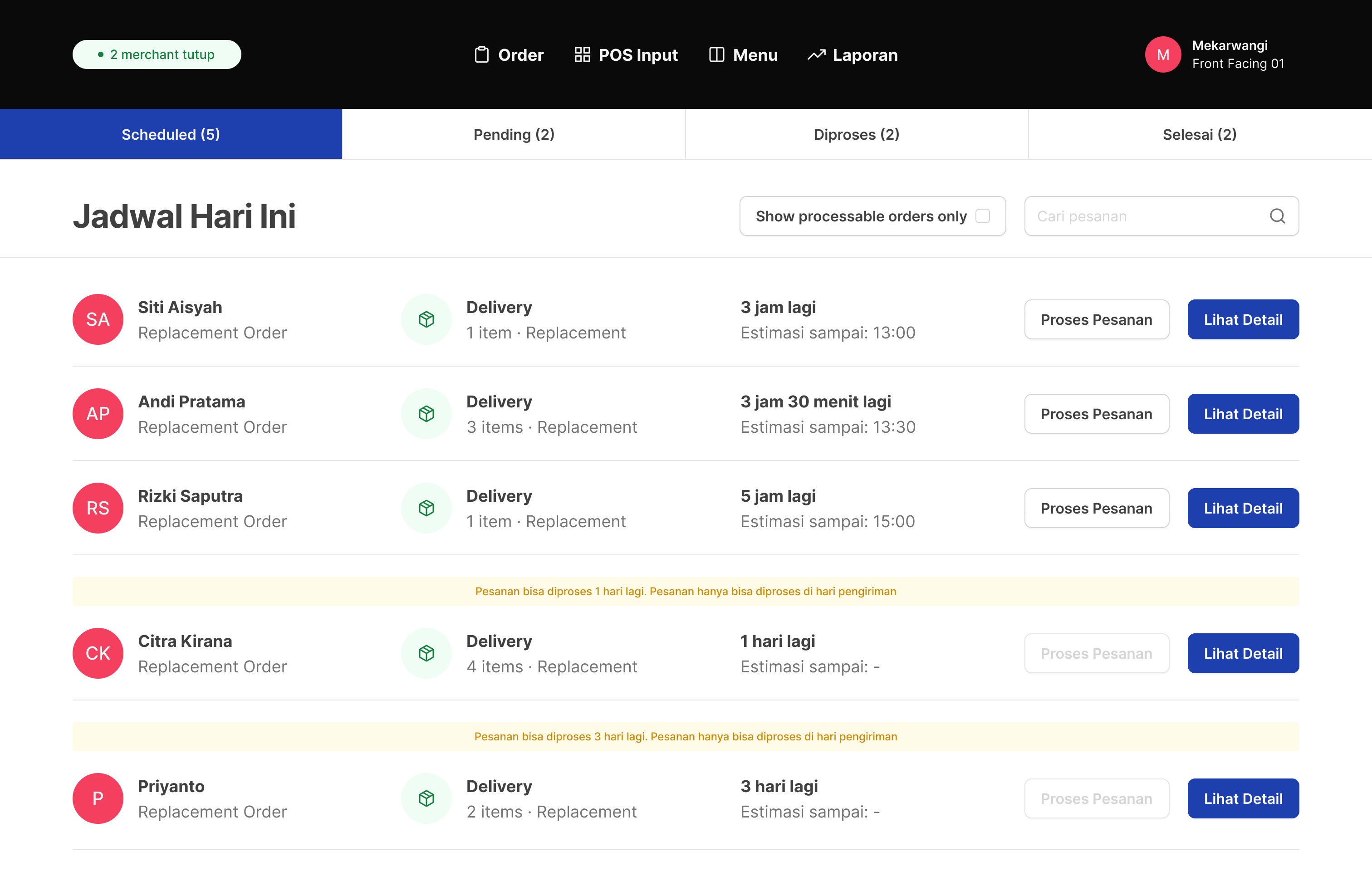
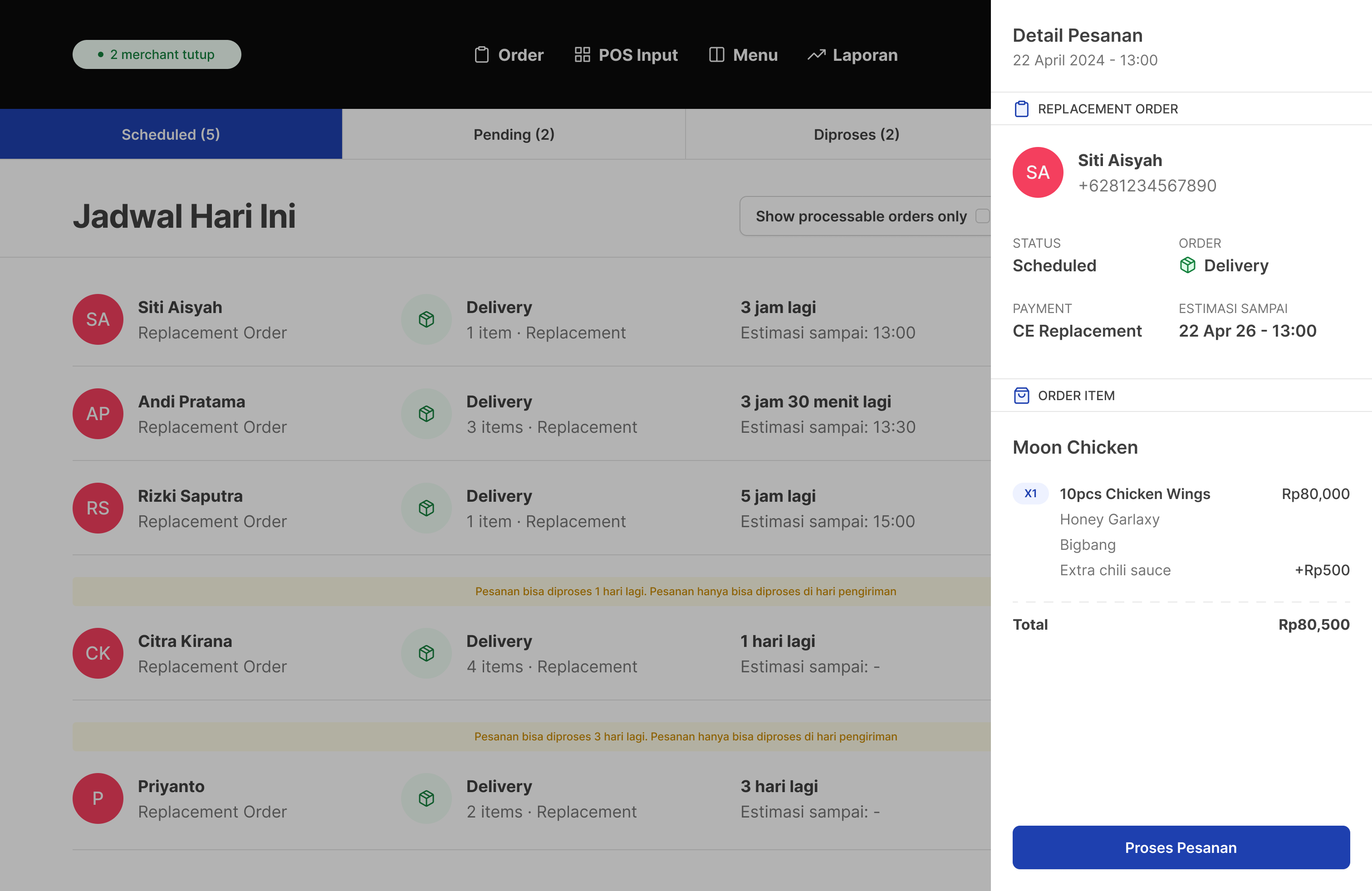
Here’s the replacement order form inside Internal Ops Dashboard that CE uses to place orders, and the scheduled order tab added to the POS so outlets can process them.
UI screens have been reskinned for confidentially. Structure and functionality reflect the actual product.
The Impact
The module shipped in February 2025. A few weeks after it, I checked back in with Regina.
The tools was stable, almost no issues after we clearing up the early bugs. Regina said: the centralization meant she could actually see what was happening across the team, something that simply wasn’t possible before.
But still, the number that stuck with me was the time:
BEFORE
Around 10 min
Per replacement order via Hangry App
AFTER
Around 2-3 min
Per replacement order via Replacement Order Module
REPLACEMENT ORDER WORKLOAD
70% Faster than before
Based on Regina’s interviewed
For the cost side was harder to quantify precisely, but the structural shift was clear, replacement orders were no longer being placed at customer-facing prices. Internal pricing through Internal Ops Dashboard meant every cost less than from the Hangry App.